
Are You Prepared When Quantum Computing Becomes Real?
The time is now to start learning quantum computing

Perhaps we are at the end of technological progress as we know it. Moore’s law comes to an end.
What appears to result in a slow-down of technological progress might instead result in a disruptive change.
When this disruption happens, you’d better be prepared. If you wait until the change happens, it might be too late. Even if it is not too late to be left behind, you’d certainly miss the first-mover advantage and belong to this shift's winners.
Of course, new technologies pop up every second. You can’t jump on all of them. So, all the more important it is to make up your mind.
If you want to decide whether to enter technology, you must first become aware of an impending change. So, in this post, we look at the signs that indicate how quantum computing will disrupt our world.
The power of a digital computer increases linearly with the number of transistors. With a doubling of the number of transistors every two years, we witnessed a squared growth in the past.
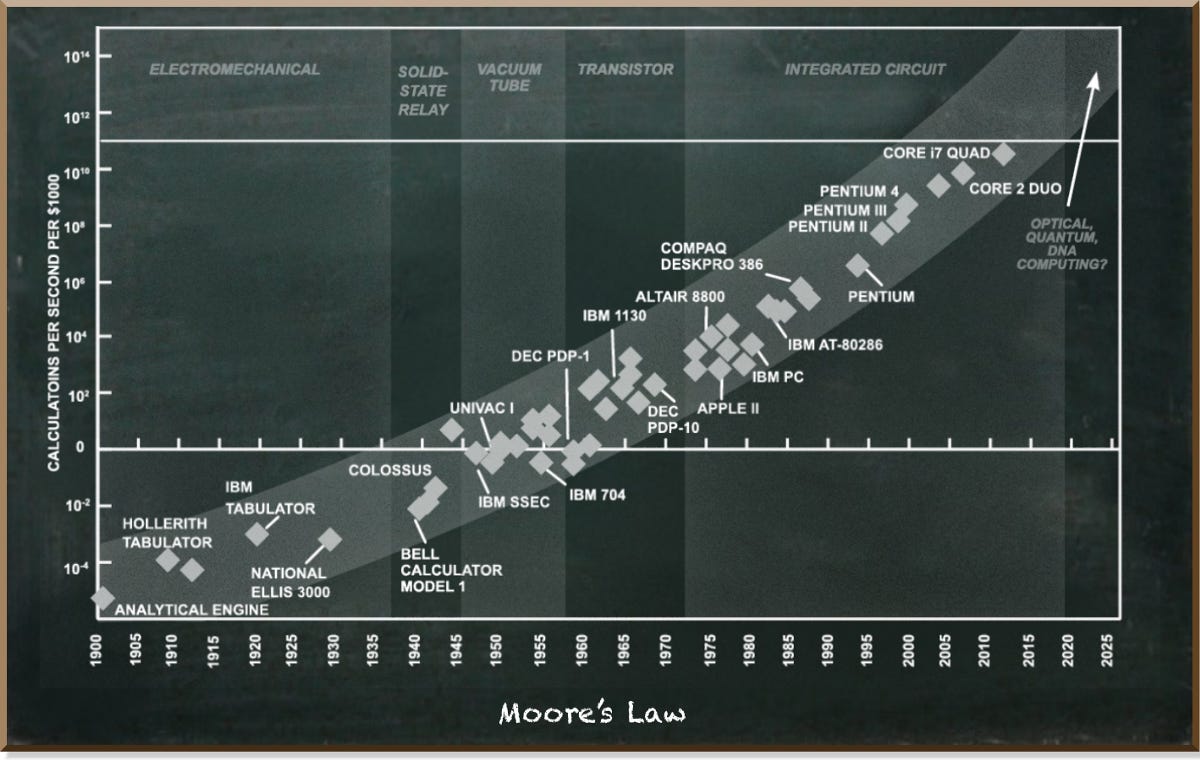
With the end of this development in mind, the prospect of solving the upcoming problems, such as fighting climate change, is poor. To reduce our ecological footprint, we need to rethink every piece of our society. Unless we want to give up our prosperity, we need to become dramatically more efficient in dealing with natural resources.
Of course, we could rely on our savvy semiconductor producers to fix the technological slow-down somehow. But not even the resurrection of Moore’s law is sufficient to solve the urgent problems.
Let’s take the simulation of molecules, for instance. Knowing how they behave would allow us to forgo experiments. It is said to speed up material development significantly. But the simulation of any molecule of interest is intractable because the complexity of simulating a molecule increases exponentially with the number of its atoms.
Even if Moore’s law continued, we would never be able to simulate molecules with more than 30 atoms.
Consequently, we do not only need to think entirely differently about how we deal with natural resources but also about computation. Solving exponential growth problems demands computers whose power grows exponentially, too.
Fortunately, these computers exist already. We’re talking about quantum computers. Their processing capacity increases exponentially with the number of quantum bits. And manufacturers of these devices have ambitious roadmaps to deliver devices powerful enough to exceed the abilities of any classical computer.
Thus far, Moores's law has disguised the dramatic change we need. It enabled us to solve new problems consistently, even if they were not the most pressing ones. But once this distraction ceases to exist, we are more pressured to develop new ways to solve our problems. The ever-growing performance of classical computers has put the bar high to prove a quantum advantage.
Yet, the technological advantage is not the decisive factor for a change. In the past, we witnessed dramatic delays between discovering new technology and its transition to the mainstream.
Let’s take the development of the steam engine, for instance. Heron of Alexandria, a Greek-Egyptian mathematician, developed the Aeolipile in the first century AD. It is a simple, bladeless radial steam turbine that spins when the central water container is heated.

However, at the time, enslaved people were the predominant source of labor. They were cheap and could do a lot of work. Therefore, there was no need for steam engines. It took more than 1,600 years until steam engines proved their advantage over human work and resulted in the industrial revolution.
So, usually, the decisive point is whether technology provides a competitive advantage in markets. And for new technologies that are not yet optimized for output, they typically appear inferior at first sight. Only when they mature can they bring their advantages to bear and outperform their predecessors.
The following image depicts the common trajectory of innovations. They are usually S-shaped. After a relatively flat initial phase, the value of technology grows significantly until it reaches its full potential. At this late phase, the growth slows down.
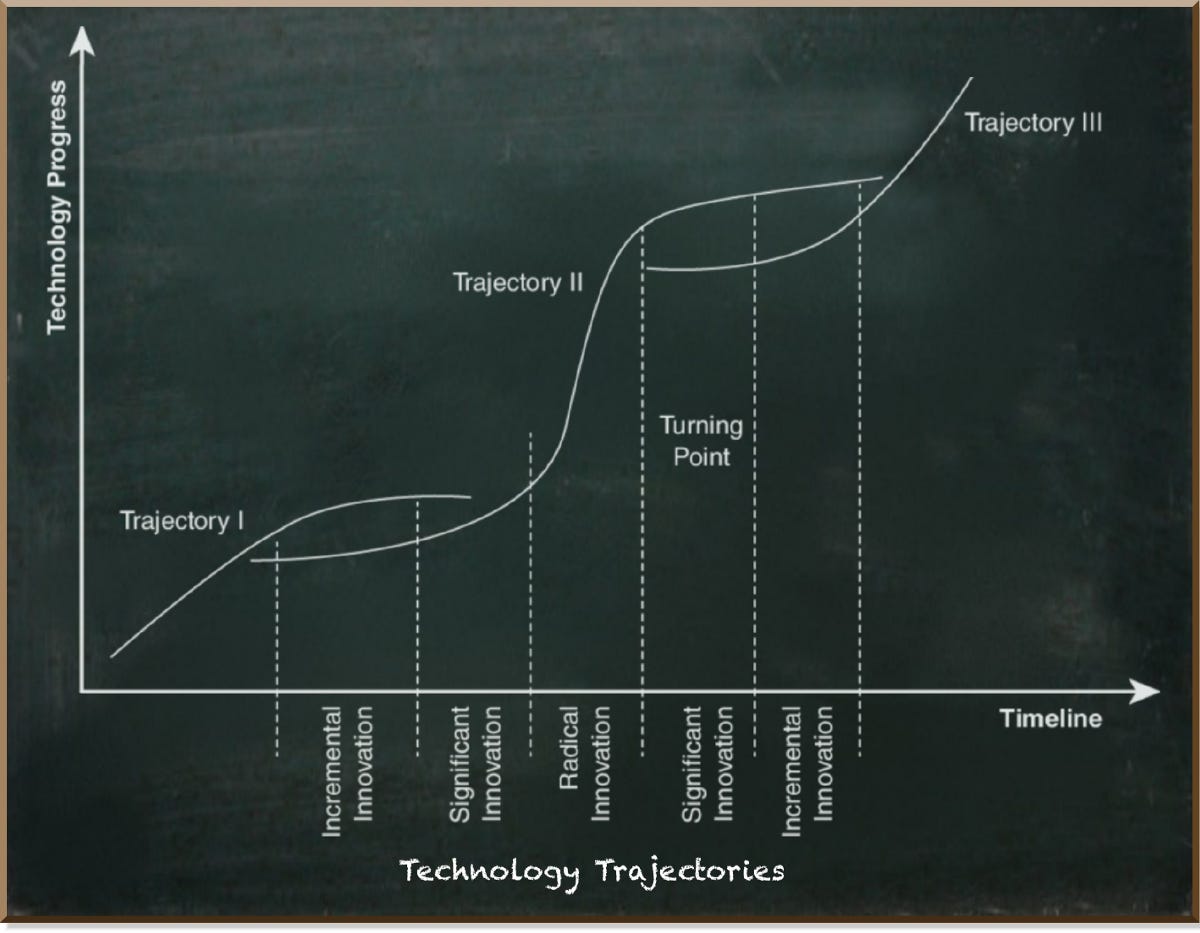
We expect classical computing to have reached this late phase. The end of Moore’s law is a strong indicator. It doesn’t mean that there will be no progress anymore. Yet, we can’t expect significant improvements on this trajectory anymore.
By contrast, new technologies have the potential for radical growth. We yet have to tap them. However, there is no guarantee that every technology will exhibit such growth. Moreover, we have also witnessed that allegedly inferior technologies persisted in the past.
On the other hand, we also saw that access to a new kind of technology leads to the least anticipated yet most profound outcomes. For instance, let’s take Eniac — the Electronic Numerical Integrator and Computer.
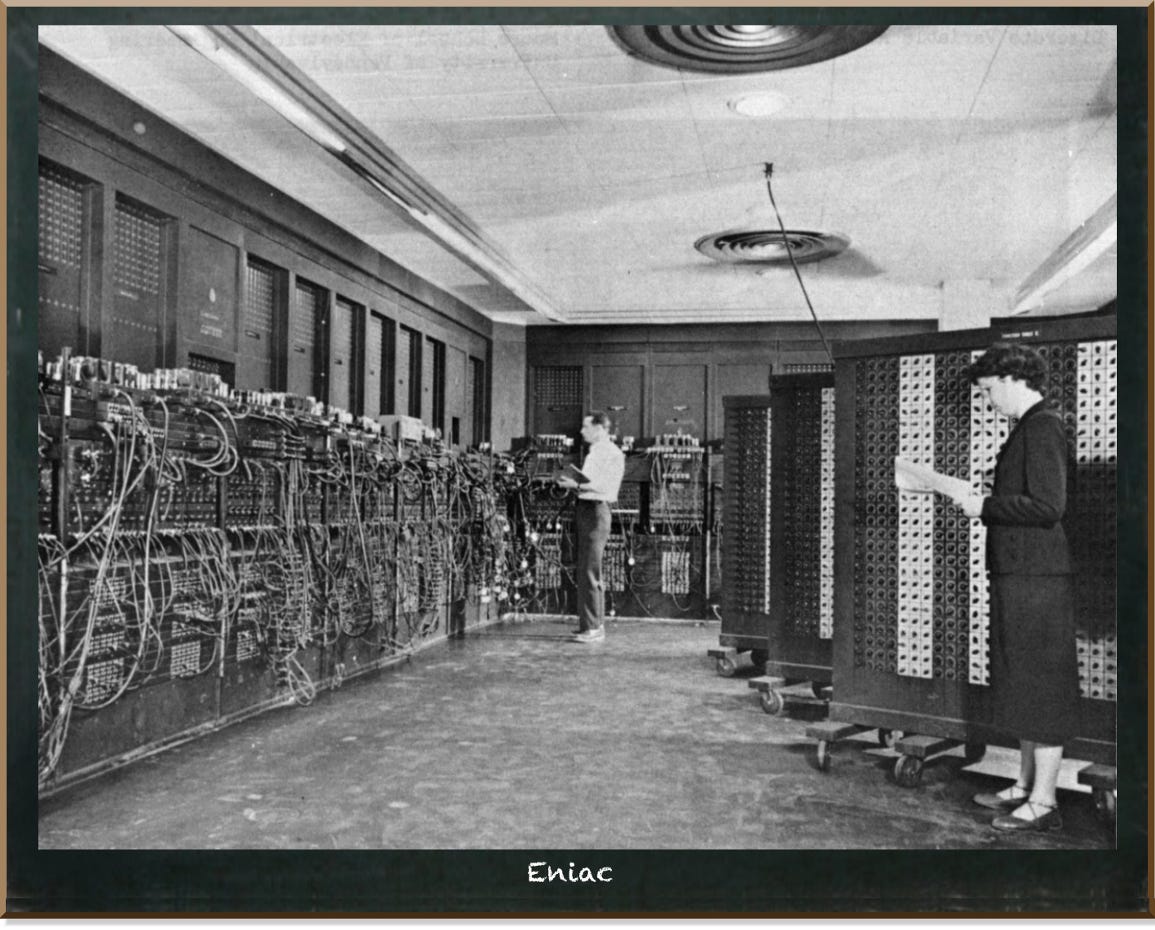
It was the first digital electronic computer that performed calculations more or less in the same way that today’s microprocessors do. Built at the University of Pennsylvania, the US military implemented it in 1946. Back then, its only application was to calculate the trajectory of artillery projectiles.
However, the second world war was over, and there was little practical use for it anymore. So they didn’t know what to do with it.
Yet, scientists and engineers were thrilled at the possibilities that could follow. Undoubtfully, they were proven right. Digital computers revolutionized our whole society.
Quantum computing is a potentially disruptive technology. And the signs indicate that quantum computing will indeed change our world.
The resulting question is how to cope with this new technology.
“But isn’t quantum computing something for physicists and mathematicians only?” Isn’t it hard to learn?”
Essentially, no.
Let’s take machine learning. There are deep parallels between machine learning and quantum computing.
The concepts and ideas of machine learning and quantum computing date back to the 20th century. Moreover, the underlying theory consists of a lot of math, making it hard to enter unless you’re a mathematician or a physicist.
But it wasn’t theoretical discoveries that triggered the unprecedented momentum of machine learning. Advances in hardware, available data, and classical software engineering enabled us to train deep neural networks.
Today, you don’t need to understand the underlying math to program a neural network fully. There are frameworks such as TensorFlow and PyTorch that take care of all the heavy loading. All you need to care about is whether the model you train can capture the patterns you aim to recognize.
We witnessed the same situation with quantum computing in machine learning in 2014. While the topic appears overly complex and theoretical, advances in math and physics are not the decisive factors determining breakthroughs.
To hide the mathematical complexity, software manufacturers have already advanced their quantum software development kits (QDKs), such as Cirq and Qiskit.
If you are in IT, you are faced with new programming paradigms, languages, frameworks, and libraries all the time. Quantum computing is no different here.
The time is now to start learning quantum computing. You can either miss the quantum computing bandwagon, too or be ready this time when a new technology sets out to disrupt the world.
You're interested in quantum computing and machine learning...
...But you don't know how to get started?
