
Chapter 4
The progress continues

Yesterday, I published the next update on Hands-On Quantum Machine Learning With Python Volume 2: Combinatorial Optimization.
In chapter 4, we look at the Maxcut problem and how we can solve it classically. Maxcut
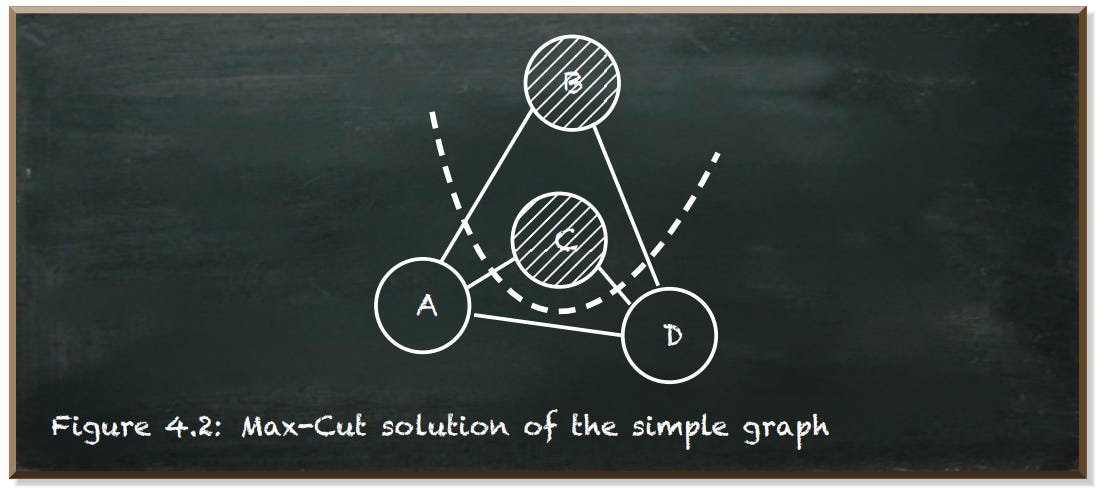
Max-cut is a popular combinatorial problem. On the one hand, it is simple to explain and does not have many rules. On the other hand, it is a complex problem—NP complex to be precise. The brute-force solution, for a graph with 𝑛 vertices and 𝑚 edges, takes 𝑂(𝑚⋅2^𝑛), since there are 2^𝑛 different vertex partitioning options.
The inability to solve this problem efficiently makes it a perfect candidate to be solved with a quantum computer.
Do you want to learn how to use quantum computing to solve combinatorial optimization problems? Have a look at my new book Hands-On Quantum Machine Learning With Python Volume 2: Combinatorial Optimization.
I will publish the book chapter by chapter. Sign up for early access to all finished sections.
But, before we look at how to solve this problem with a quantum algorithm, we first solve it classically. And this is what we do in chapter 4.
In my weekly post, today, I would like to share some insights about the importance of representation. Even though we think data is objective, it is not—at least not its representation. Therefore, “Don’t judge your data by the way it looks!”
You're interested in quantum computing and machine learning...
...But you don't know how to get started?
